Diagnosing your Innovation Performance Gap
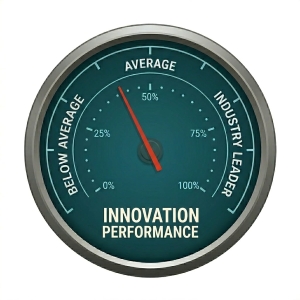
“I’d invest more in innovation tomorrow — if I trusted our system to deliver a better return.”
If that sounds familiar, you’re not alone. Most leadership teams aren’t under-investing in innovation. They’re under-performing on the return from what they already invest. More budget hasn’t closed the gap. And yet, the instinct is still to fund more — rather than to ask why.
When we diagnose that gap, three problems show up consistently:
1) Absence of a shared, evidence-based picture of what’s broken.
Every executive has a different diagnosis — strategy, resources, process, teams. Without an objective baseline, the conversation circles. The leadership team gets stuck debating the starting point.
2) Lack of organizational awareness to build genuine buy-in.
Top-down mandates to “fix innovation” rarely work. The organizations that make lasting change put the evidence in front of the people closest to the work — the cross-functional teams and managers — and let them see their own practices benchmarked against what the best innovators do. That transparency builds ownership of the solution.
3) No concrete, prioritized plan.
“Transform innovation” is not a plan. The companies that move fastest identify the five or six specific problems causing most of their underperformance — and fix those first, in the right sequence.
The research is unambiguous.
The average business sees fewer than 40% of projects meet profit objectives and only 26% launched on time. Companies operating within a disciplined innovation framework deliver 2x the commercial success rate from the same level of investment. (Source: APQC — American Productivity and Quality Center)
That performance gap changes everything. Poor yield drives executives toward safer projects to defend market share. High yield enables bolder innovation — the kind that grows revenue and EBITDA by taking market share and entering new markets.
The gap between average and top performers is rarely about budget size. It’s about whether the system — portfolio governance, cross-functional teams, market discipline, and process rigor — is built to convert investment into results.
Getting that picture clearly, objectively, and with enough organizational depth to act on it is the hardest part. It requires your own organization’s evidence, benchmarked against the world’s best innovators, with enough cross-functional breadth to reveal where the real disconnects live.
That’s the work that comes before the plan. And it’s the work that makes the plan succeed.