The Stage-Gate Model: An Overview

Stage-Gate®: The Official Version
For over forty years, the Stage-Gate® process has served as the dominant framework for managing new product development (NPD).[1] Around the world, organizations rely on Stage-Gate® not only as a disciplined roadmap for managing innovation but also as a proven system that consistently transforms their best ideas into profitable, winning products. Few business processes have had such a lasting impact on corporate innovation performance.
At its core, Stage-Gate® is both a value-creation engine and a risk-management governance model. It systematically guides projects from idea to launch by embedding the critical principles, best practices, and success drivers identified through decades of research on what truly produces superior, winning new products.
Right Projects Right
In practice, Stage-Gate[†] is a roadmap for moving a new product project from idea to launch – a structured, end-to-end guide for transforming new ideas into successful commercial products.[2] It provides clarity, discipline, and direction in an area of business that is often ambiguous, risky, and highly cross-functional. By organizing the innovation journey into clearly defined Stages of work and decision-making Gates, the system ensures that development is both effective (doing the right project) and efficient (doing the project right).[‡]
The Stage-Gate® roadmap embeds decades of empirical research into what makes certain new products succeed while others stumble. These best practices and critical success drivers are deliberately woven into each Stage and Gate of the model. When properly executed, the process becomes not just a useful guide but a powerful mechanism for greatly improving the probability of market success. In many organizations, Stage-Gate® has become the backbone of their product innovation governance.
The Industry Standard
At the heart of the model is the division of the innovation process into discrete, manageable Stages. A new-product project progresses through these Stages, each containing a prescribed set of parallel, cross-functional tasks that generate the information needed to advance the project.
Stage-Gate® is also an effective governance model for NPD. Before entering any new Stage, the project must go through a Gate – a go/kill and resource-allocation decision point where senior leaders assess the project’s business value, readiness, and continued alignment with business priorities.
This architecture – Stages followed by Gates – gave rise to the name Stage-Gate®, which has been used since the late 1980s and is now recognized globally. While some organizations refer to their models as “phase-Gate,” “phase-review,” or “gated development,” the Product Development & Management Association (PDMA) formally recognizes Stage-Gate® as the industry standard. The PDMA’s Handbook defines it as:[3]
“Stage-Gate® Process: a widely employed product development process that divides the effort into distinct time-sequenced Stages separated by management decision Gates. Multifunctional teams must successfully complete a prescribed set of related cross-functional tasks in each Stage prior to obtaining management approval to proceed to the next Stage of product development. The framework of the Stage-Gate® process includes workflow and decision-flow paths and defines the supporting systems and practices necessary to ensure the process’s ongoing smooth operation,”
Undisputed Track Record
Stage-Gate® quickly gained traction after its introduction because companies saw immediate improvements in performance.[4] Over the years, the case for Stage-Gate® has only become stronger:
- A major APQC benchmarking study found that 88% of U.S. firms involved in NPD apply Stage-Gate® to manage their projects from idea to launch (E.g. 1st Generation Stage-Gate through to 5th Generation Stage-Gate Maturity).[5]
- These companies reported benefits such as improved cross-functional teamwork, higher success rates, stronger early detection of failure, better launch outcomes, and significantly shorter cycle times – often reduced by 30%.
A more recent global study by PDMA found that about 54% of firms worldwide use Stage-Gate® or a similar structured process.[6] This study concluded that “…faster cycle times result from the use of a formal, structured NPD process such as functional phase review, cross-functional Stage-Gate, or agile,” with Stage-Gate® being the more popular.
Hallmarks of an authentic Stage-Gate® Model
- Customer-Centric: The leading cause of new product failure is a lack of understanding of customers and users – their problems, needs, and purchasing criteria. Stage-Gate® addresses this directly by hardwiring customer and user engagement into every Stage, from idea generation through launch. Structured Voice of Customer (VOC) work, rapid concept and prototype testing, and customer co-creation activities become “must do” work, not optional extras that can be skipped under time pressure. This customer-centric design consistently reduces failure rates and leads to products with compelling, differentiated value propositions.
- An Effective Governance Model: to ensure that the right R&D investments are made: A pervasive challenge in product innovation is making sound project investment decisions when information is incomplete and risks are high. Stage-Gate® embeds a rigorously designed governance mechanism at each Gate to support better go/kill and resource-allocation decisions. The result is a more focused portfolio, fewer weak projects, and a higher return on R&D spending.
- A Risk-Mitigating Model: NPD Stages require significant spending: engineering work, market studies, and prototype fabrication all take time and money. But in Stage-Gate®, as investment levels rise with each Stage, information also improves. It’s much like placing progressively larger bets in five-card stud poker: As the amounts being bet increase, so does the quality of information. The result: an incremental investment model, thus risk is managed!
- An Adaptive and Agile System: 4th and 5th Generation versions of Stage-Gate® integrate methods originally developed in the software world – frequent build‑and‑test cycles, rapid customer validation, and in‑Stage sprints. This creates a process that is both structured and adaptive. As new market or technical information arises, plans and product definitions can pivot while dynamic Gates reassess project value. Leading firms use this adaptive Stage-Gate® to respond quickly to uncertainty, reduce time to market, and still maintain the governance and discipline demanded by senior management.
- Cross Functional: A new-product project is very much a cross functional initiative; but often some, departments such as Sales and Operations get left out until too late. The way Stage-Gate® is designed requires the active engagement of the necessary functions, both within the Stages and also at the Gates. Project teams are composed of people from key functions, and each Stage includes parallel tasks owned by different disciplines. There is no “handoff” between silos; rather, a single, accountable, cross-functional team moves the project from idea to launch. Gates likewise engage leaders from multiple functions, ensuring that decisions consider technical feasibility, market potential, operational readiness, and financial impact.
How Stage-Gate® Works
The flow of the typical Stage-Gate® system, shown pictorially in Figure 1, is the most current version and is for major new product projects. While the model is laid out in a logical, linear and sequential fashion as in Figure 1, in reality, there is much iteration and circling around, certainly within Stages and often between Stages, as shown by the green circles…. it’s anything but linear! The Stage-Gate® system is very much adaptive and iterative (see Figure 1).
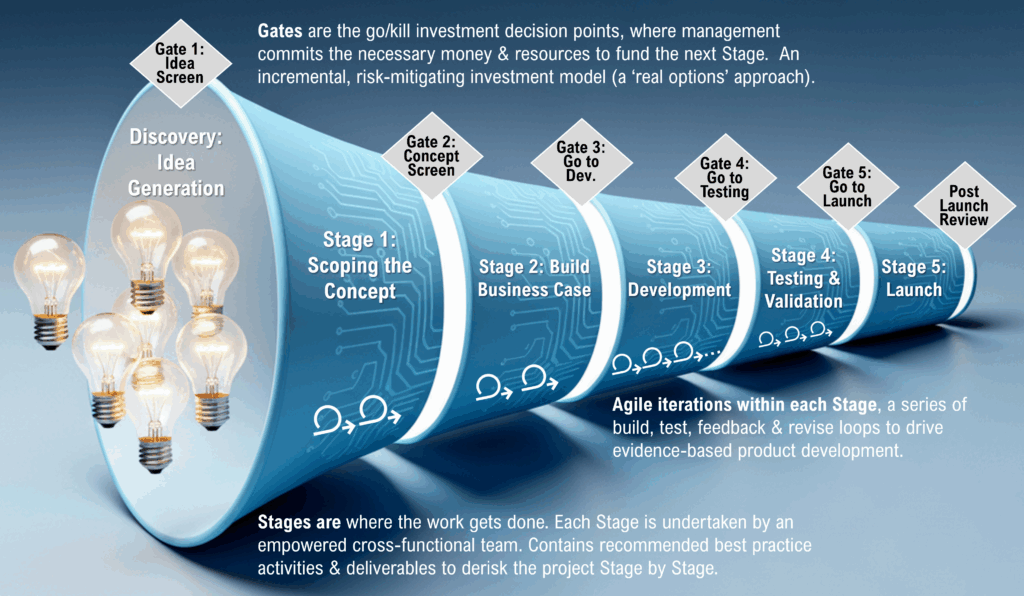
Figure 1: Official Stage-Gate® Model for New Product/Solution Development (5-Stage, 5-Gate Process Rigor)
The Stages – Where the Work Gets Done:
The Stage-Gate® system for major new products and solutions is right-sized for context and risk, therefore, includes discovery plus five Stages: [7]
Discovery and Ideation: Upstream activities designed to uncover opportunities and generate ideas.[8] Inputs can come from customers, internal R&D, open innovation partners, suppliers, and strategic initiatives. The aim is to populate the front end with strategically aligned high-potential ideas.
Stage 1 – Concept: A quick, preliminary assessment of the idea. Teams conduct initial market and technical scoping, leveraging desk research and fast secondary analysis. The outcome is a clearly articulated concept, with a first view of attractiveness and feasibility.
Stage 2 – Build the Business Case: A more detailed and evidence-based investigation. This Stage typically includes primary market research, VoC, technical feasibility studies, value proposition clarification, financial evaluation, and risk assessment. The key output is a robust business case, specifying the product definition, market positioning, financials, and a plan for the next Stage or Stages.
Stage 3 – Development: Detailed design and development of the product and supporting operations or production processes. Activities include engineering design, optimization, simulations, prototyping, and process design. For process industries, this Stage often involves molecular discovery or material design and lab development, lab trials, and simulations. The main deliverable is a fully functioning prototype (or equivalent) ready for customer and field testing.
Stage 4 – Testing and Validation: Rigorous validation of the product, the marketing mix, and the production or service delivery system. This Stage typically includes beta tests, user pilots, field trials, extended lab testing, and trial production runs. The goal is to confirm that the product performs as promised, the market will accept it, and operations can deliver reliably at scale.
Stage 5 – Launch: Full commercialization – ramp-up of manufacturing or operations; execution of the launch, sales, and marketing plans; and roll-out to target markets. Post-launch, the team continues to monitor performance, resolve issues, and drive product and process improvements until a formal post-launch review is completed and accountability transitions into routine business management.
The Gates – Where Governance Occurs:
Preceding each Stage is a Gate – an explicit decision point where the business must choose whether and how to continue investing. Gates are not ‘backward-looking’, status reviews and project approval meetings; they are ‘forward-looking’, where resource commitments are made! At each Gate, senior managers (the Gatekeepers) engage in a robust discussion, assess progress and project value to the business, and decide whether the project merits further funding and people for the next Stage.
Each Gate typically comprises three components:
Gate deliverables: Defined outputs from the previous Stage – such as research findings, technical results, financial analyses, and updated project plans – brought by the project team to support the decision. Because deliverables are clearly specified ahead of time, expectations are transparent and teams know what they must produce to move forward.
Gate criteria against which the project is judged: They include both project readiness and project value. Readiness criteria address whether the project is sufficiently mature for the next Stage. Business Value criteria evaluate the attractiveness of the opportunity, often using a risk-adjusted financial model such as Expected Commercial Value,[9] and a research-based scoring model such as the VBS (Value-Based Scorecard).[10] This combination yields a more reliable view of value than traditional financial models alone, whose data are often uncertain or biased.[11],[12]
Gate outputs: A clear decision and an agreed plan. Typical outcomes are Go, Kill, Hold, or Recycle. For Go decisions, the Gate also confirms the resourcing for the next Stage (budget, headcount, and person-days), timeline, key deliverables, and the date of the next Gate. This avoids “approval without resources” and ensures that authorized projects can move quickly.
Gates are designed to engage senior managers from different functional areas, who own/control the resources required by the project leader and team for the next Stage. They are called the Gatekeepers and are a predefined group for each of the five Gates. For larger projects requiring more resources, Gates 3, 4, and 5 engage with the leadership team of the business. The project team should be at the Gate meeting.
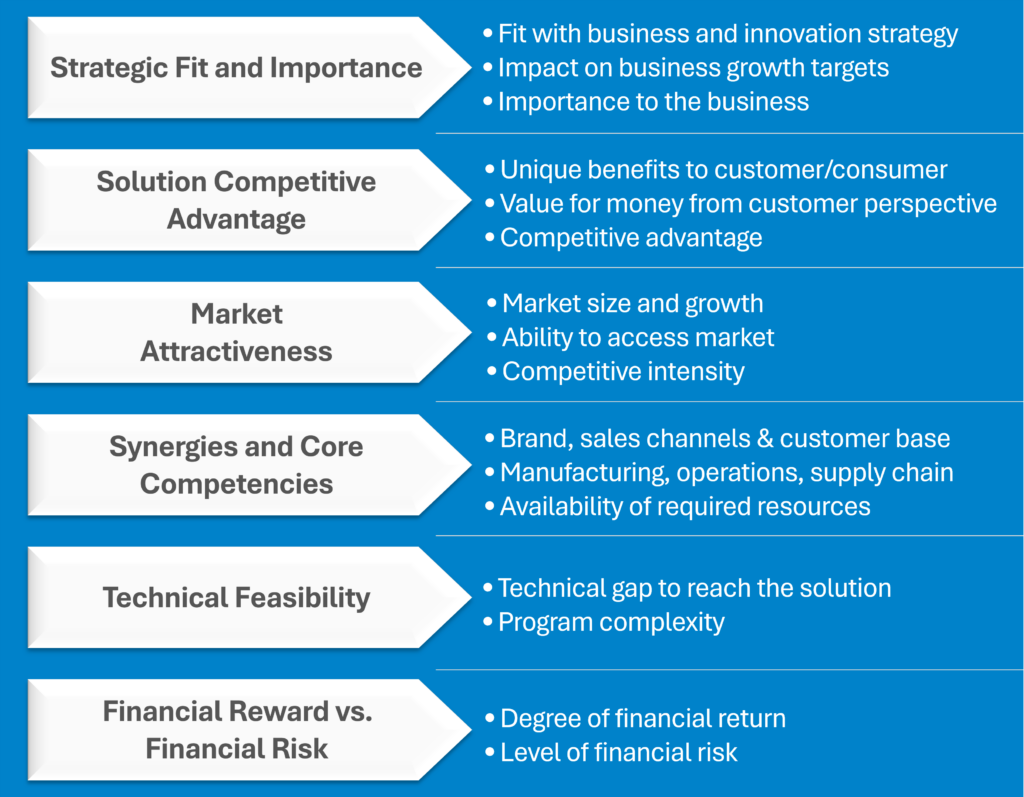
Figure 2: Sample Value-Based Scoring Method
Conclusion
Stage-Gate® thus provides an integrated value-creation and governance system that translates high-potential ideas into well-validated, commercially successful products while systematically managing risk at every step. By embedding customer insight, disciplined decision-making, and adaptive, agile practices into a single end-to-end model, it remains the global benchmark for organizations seeking to improve innovation performance and return on R&D investment.
Stage-Gate® drives speed and quality of execution of product innovation activities. The process helps project teams prepare the right information, with the right level of detail, at the right gate to support the best decision possible. The process empowers the project team by providing them with a roadmap with clear decisions, priorities, and deliverables at each gate. High quality deliverables submitted to Gatekeepers enables better, more timely and fact-based decisions for allocating capital and operating resources.
A Complete Innovation Performance Framework
The conceptualization and development of new products and technologies is one of the more complicated initiatives an organization can undertake as new ideas migrate from ideation through the feasibility, development and scale-up stages and, finally, into commercialization. The Stage-Gate® process is a time tested and proven roadmap to guide an organization to success.
Top performing companies have come to realize that this is only one piece, albeit a critical part of their internal innovation capability. Additionally, top performers have taken steps to ensure that their innovation strategy, portfolio management and culture is aligned and integrated with their Stage-Gate® process.

Figure 3: The Stage-Gate® Innovation Performance Framework
Top performing companies master all four critical capabilities – do you?
Explore the products, programs and services we offer to help your organization to master Stage-Gate® and the Innovation Performance Framework.
References
[†] The term “Stage-Gate” was created by the author and it first appeared in print in 1988. Stage-Gate® is a registered trademark in the United States of Stage-Gate International Inc. and in Canada and Europe of Robert G. Cooper.
[‡] A “product” is anything that one takes to the marketplace for sale or consumption; can be an intangibles (service product) or a tangible (physical product), also an IT (software) product; and any combination of these.
[1]. Cooper, Robert G. (Dec. 2022). “The 5th Generation Stage-Gate Idea-to Launch Process,” IEEE Engineering Management Review (50), 4: 43–55. https://doi: 10.1109/EM
[2]. Cooper, Robert G. (2017). Winning at New Products: Creating Value Through Innovation, 5th edition, New York, NY: Basic Books, Perseus Books Group, 2017
[3]. Cooper, Robert G. (1988). “The New Product Process: A Decision Guide for Managers,” Journal of Marketing Management 3, 3: 238–255.
[4]. Cocchi, N., Dosi, C., and Vignoli, M. (2021). “The Hybrid Model Matrix: Enhancing Stage-Gate with Design Thinking, Lean Startup, and Agile,” Research-Technology Management (64) 5: 18–30.
[5]. PDMA Handbook (2013). The PDMA Handbook of New Product Development (3rd ed.), ed. by Kenneth B. Kahn. Hoboken, NJ: John Wiley & Sons Inc.: p 34. ISBN 978-0-470-64820-9.
[6]. Knudsen, Mette P., von Pedowitz, Max, Griffin, Abbie, and Barczak, Gloria. (2023). “Best Practices in New Product Development and Innovation: Results from PDMA’s 2021 Global Survey,” Journal of Product Innovation Management (40): 257–275. https://doi: 10.1111/jpim.12663. Best practices in new product development and innovation: Results from PDMA’s 2021 global survey
[7]. Cooper, endnote [2].
[8]. Cooper, Robert G. and Dreher, Angelika (Winter 2010). “Voice of Customer Methods: What is the Best Source of New Product Ideas?” Marketing Management Magazine: 38–43.
[9]. Cooper, Robert G. (June 2023). “Expected Commercial Value for new-product project valuation when high uncertainty exists.” IEEE Engineering Management Review 51(2): 75-87, doi: 10.1109/EMR.2023.3267328.
[10]. Cooper, Robert G. and Sommer, Anita F. (2023). “Dynamic Portfolio Management for New Product Development.” Research-Technology Management 66 (3): 19–31, https://doi: 10.1080/08956308.2023.2183004
[11]. Mitchell, R., Phaal, R., Athanassopoulou, N., Farrukh, C., and Rassmussen, C. (2022). ”How to Build a Customized Scoring Tool to Evaluate and Select Early-Stage Projects.” Research-Technology Management 65 (3): 27–38. https://doi: 10.1080/08956308.2022.2026185
[12]. Cooper and Sommer, endnote [10].