Diagnosing your Innovation Performance Gap
Eight Game-Changing Updates to Modernize Your Stage-Gate® Framework
The Stage-Gate® Innovation Performance Framework continues to evolve, and the pace of advancement has accelerated. With thousands of firms relying on the method worldwide, new practices, refinements, and powerful enhancements inevitably emerge. These innovations are enabling companies to:
- execute projects faster
- boost new product development (NPD) productivity
- tailor Stage-Gate® to a wider range of business models and diverse innovation portfolios
Here are the eight most significant advances shaping the next generation (5th Generation) of Stage-Gate®, which every innovation leader should understand and incorporate into their innovation practices:
1. Iterative
2. Agile
3. AI Powered
4. AI Agentic
5. Deploy AI solution projects
6. Parallel Processing
7. Eco Stage-Gate
8. Tailored to Different Project Types
1. Iterative Stage-Gate®
In 1st Generation Stage-Gate®, the product was fully defined before the project moves into the Development Stage – a fairly early “frozen product definition”. Indeed, “sharp, early and fact-based product definition” was a fundamental principle of the original Stage-Gate approach: research showed that a clear product definition would speed technical development work.
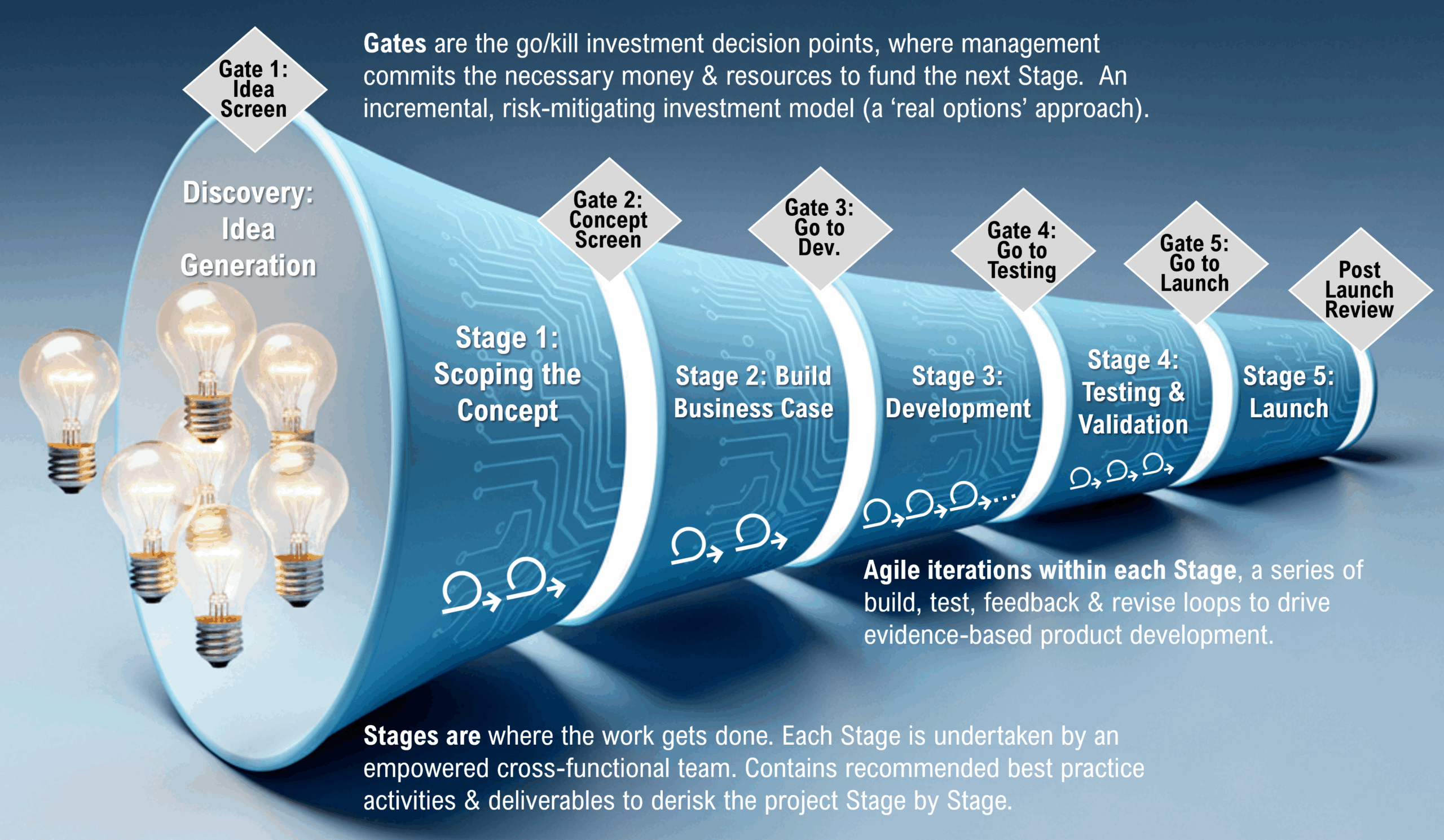
Figure 1. The full Stage-Gate® process. Five Stages and Gates, with iterations built in, for major new solution projects.
For some businesses, markets, and projects, however, the product definition can and should evolve as Development in Stage 3 proceeds. Often, customers are not clear on what solutions best fit their needs: As Steve Jobs said, “People don’t know what they want until you show it to them”. Additionally, things change: Part way through development, a new important customer need is identified, a new competitive product appears, or a new technical solution emerges, rendering the original product definition insufficient.
Iterative Stage-Gate incorporates structured iterations so that product definitions can evolve during Development.[1] The product may be less than 50% defined as the Development Stage begins, but its definition evolves and solidifies over the course of Development. As shown in Figure 1, iterations are cycles of “build, test, feedback, and revise”. Technical and end user feedback is sought with each iteration so that necessary product adjustments can be made. These multiple iterations guide the team towards a solution that truly resonates with customers and is technically robust.
Such iterations occur in other Stages, such as creating and testing virtual concepts in the Scoping Concept Stage. This Iterative Development philosophy encourages teams to fail fast, fail early, and fail cheaply, using early negative feedback as a source of learning rather than as a setback.
2. Agile Stage-Gate®
Agile Development methods were developed in the 1990s in the software world to deal with IT projects with dynamic requirements and uncertain information. Agile emphasizes short sprints, frequent builds, continuous customer feedback, evolving backlogs, and empowered, dedicated teams.
Recognizing the potential benefits, many companies have adopted Agile principles for physical products by simply integrating them into some of the Stages of Stage-Gate®. In an Agile-Stage-Gate® hybrid model:
- Stage-Gate® defines the overall pathway structure – the Stages, Gates, and major deliverables.
- Within the development-related Stages, teams execute work in Agile sprints, delivering incremental prototypes or product versions in weeks rather than months.
- Traditional Gantt charts and plans give way to sprint backlogs, velocity tracking, and frequent demos to stakeholders and customers.[2]
Using Agile Stage-Gate®, leading physical product firms, such as Honeywell, GE, and LEGO, have reduced time to market as well as being able to respond quickly to changing customer requirements.[3]Adopting Agile is not in conflict with Next-Gen Stage-Gate®, rather the two systems are complementary.[4] Stage-Gate® provides governance, a roadmap through to launch, and portfolio discipline. Agile brings speed, adaptability, and continuous learning to project-manage each Stage. Together, they deliver “agility with discipline”[5] – a combination increasingly necessary in complex innovation environments.
Additionally, Agile Stage-Gate® works well for “smart connected products” involving both physical product and software development teams and workstreams, according to a GAO report to the US Congress.[6] It notes that leading firms are using more effective approaches “such as a model that combines aspects of Agile and Stage-Gate®.”
3. AI Powered Stage-Gate®
Artificial Intelligence (AI) is revolutionizing all aspects of business, particularly NPD. Large early-adopter firms demonstrate that AI not only finds many applications in NPD but also offers substantial payoffs, such as 50% reductions in development times.[7] Thus leading firms are building AI into their Stage-Gate® new product processes.
In 2025, more than 40 unique AI applications from 400+ vendors existed for AI in NPD. The varied nature of the applications, from doing market research to undertaking engineering design, is exciting and somewhat overwhelming. Our positioning map for AI in NPD, showing many different AI applications in NPD, gives a visual presentation of this complex landscape (see Figure 2).[8] Across the map is where the AI application occurs in the Stage-Gate® process, while the vertical axis depicts the role of AI as an originator versus a facilitator.

Figure 2. AI powering Stage-Gate® ‘positioning map’ showing where AI is used in Stage-Gate® & its role: facilitator or originator.
In the context of Stage-Gate®:
- Front end: AI tools and large language models (LLMs) support idea generation, opportunity scanning, concept screening, market research, and even building the business case at a fraction of the time and cost of traditional methods.[9]
- Development and testing: Digital twins and advanced simulation models enable rapid technical and user testing for design optimization without requiring physical prototypes. AI also designs and tests new molecules and drugs; robots in labs synthesize compounds; and AI predicts chemical reaction outcomes.[10]
- Launch and post-launch: AI assists with launch planning, pricing, sales-force optimization, and marketing communications. AI also continuously monitors product performance and customers’ product usage, providing feedback data for the development of product improvements.[11]
Despite the reported benefits, AI adoption for NPD has been low: Only 23% of US and EU firms were using AI for any task in NPD by early 2024,[12] which had risen modestly to 28% by 2025.[13] The reasons for hesitation have been identified: A major reason is that AI installations do not yield the promised results[14] – the AI failure rate for business in general is about 80%.
4. AI Agentic Stage-Gate®
AI agents represent a major step beyond today’s prompt-driven generative AI described above in Section 3.[18] These new systems have agency: they can interpret their environment, make decisions, execute tasks, and adapt with minimal human guidance.[19]
In NPD, this means an AI agent can autonomously execute Stage 2 in Stage-Gate®, for example – it acts as an orchestra leader to integrate the various AI tools that do a market analysis, VOC synthesis, technical feasibility, competitive assessment, and financial modeling to create a business case.
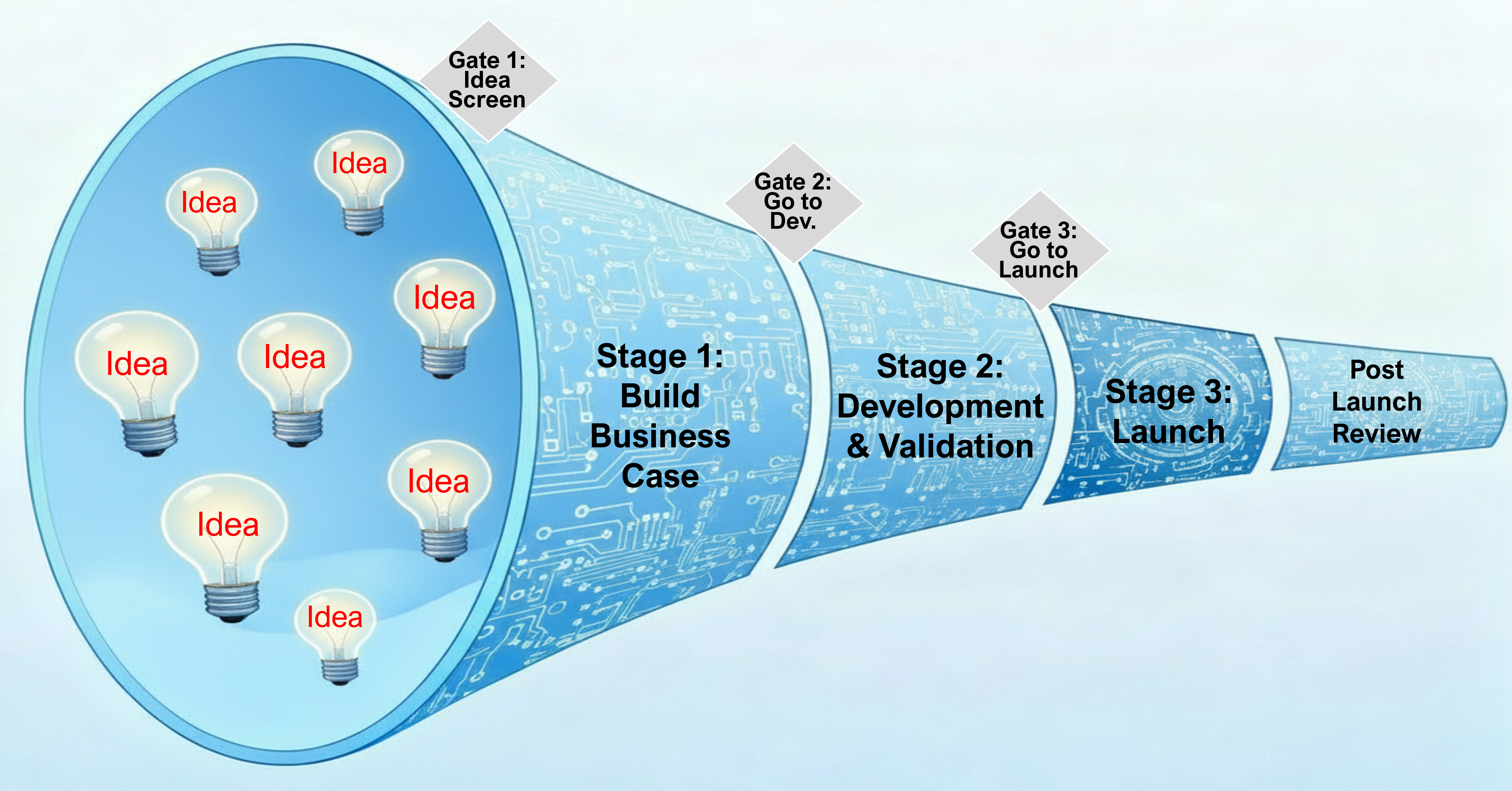
Figure 3. The new AI Agentic Stage-Gate® model, accelerated and compressed to just 3 Stages by using AI agents to orchestrate Stages and AI to semi-automate Gates.
For example, Microsoft’s RD-Agent, executes iterative R&D workflows with substantial autonomy, from idea generation through refinement, acting as a research copilot to manage multi-step R&D projects. Some Stages, such as Stage 1 in Figure 1 can be compressed from weeks to hours.
This compression imperative means that with Stages requiring minimal costs and time, AI Agentic Stage-Gate® compresses Stages and Gates, and also semi-automates Gate decision-points through robust analysis. An early prototype of AI Agentic Stage-Gate is shown in Figure 3; Stage 1 is already orchestrated by an agent.[20]
5. Use Stage-Gate® to Deploy Artificial Intelligence
Although AI promises great efficiencies and improved effectiveness, deploying AI within the business has been a challenge. Firms currently face very high failures rates of AI adoption and deployment projects – as high as 80, even 95%, according to reliable research results from the Rand Corporation, MIT, and an S&P Global study.
AI adoption and deployment projects share many characteristics with new product projects: they are both risky development initiatives; the “customer” is internal—a user group in the business—and the developed product comes from external vendors. Not surprisingly, many of the reasons for AI adoption failure are much the same as for new product failure: a lack of understanding of user needs, technical difficulties with the product, a poorly executed launch, and a siloed approach.
Some of the solutions here are the same as for NPD. For example, an IBM report recommends a seven-step “stage-gating” process for AI adoption in order to validate business impact before scaling.[15] Similarly, an MIT study of European firms emphasizes the need for incremental funding and evidence-based decision gates to minimize waste and risk.[16] Forward-looking firms are therefore applying a tailored Stage-Gate® approach to AI adoption:[17]
- Stage 1 – Build the Business Case: Clarify the user need and problem, expected benefits, risks, and business implications.
- Stage 2 – Acquisition and Alpha Testing: Select vendors and tools, run proof-of-concept trials and alpha tests, and validate technical feasibility and initial business impact.
- Stage 3 – Pilots with Users: Implement pilots in real business settings, focusing on user adoption, workflow integration, and measurable outcomes.
- Stage 4 – Scale to Production: Roll out successful solutions across the organization, embed governance and operating models, and optimize for reliability and performance.
If your business has faced challenges in adopting AI tools maybe it’s time, to consider a more structured and professional approach. This AI-focused Stage-Gate® Model provides a practical roadmap to turn experimentation with AI into successful pilots and broader deployment.
6. Parallel Processing
Time to market is often a decisive competitive factor, and parallel processing (concurrent work) has re-emerged as a powerful lever to accelerate projects. Instead of waiting for each task or stage to be fully completed before starting the next, well-designed Stage-Gate® systems allow overlapping tasks and, where justified, overlapping Stages.[21] Projects move forward as soon as critical information is sufficiently reliable, rather than waiting for “perfect data”.
Long lead-time activities, such as equipment procurement or tooling, can be initiated earlier, for example, once risk is acceptable to proceed, even while some product testing continues. The development of COVID‑19 vaccines is a high-profile illustration of this approach, as shown across the bottom of Figure 4:[22] clinical, regulatory, and manufacturing workstreams were executed in parallel, supported by rolling FDA approvals and early manufacturing commitments, compressing the expected timeline from 10 years to under a year.
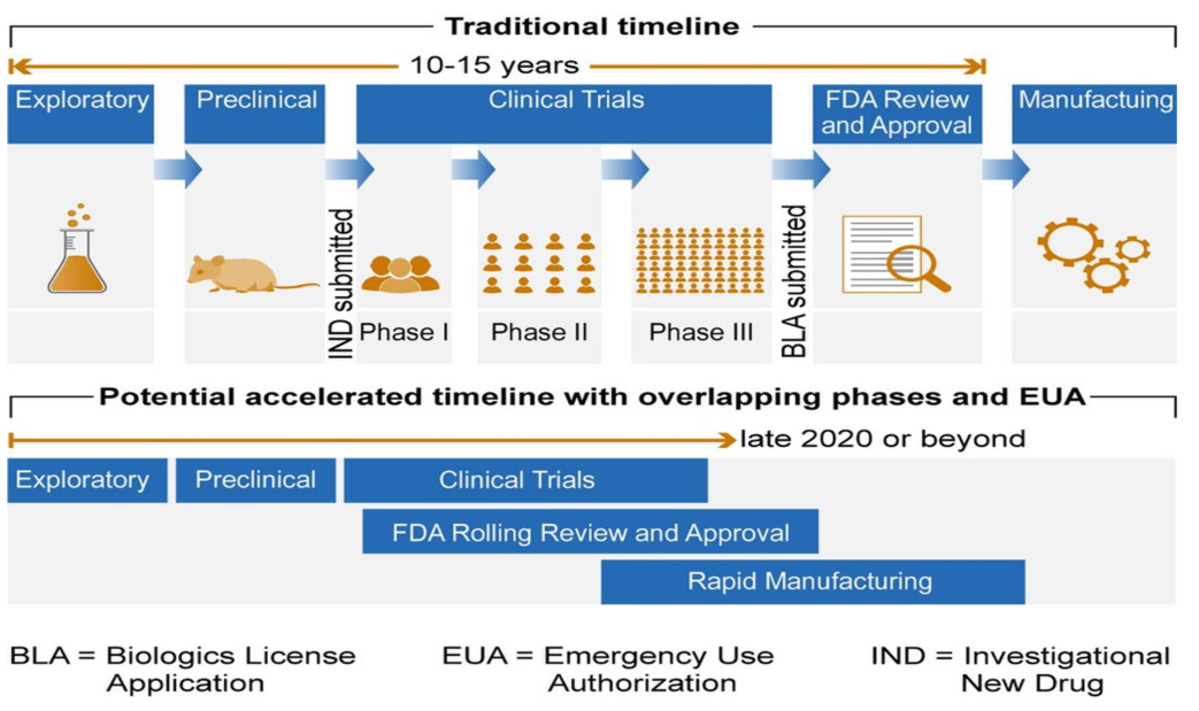
Figure 4. Parallel processing during the development of the COVID-19 vaccine across the bottom of the figure—accelerated the project by overlapping stages, and moving decision points forward (source: GAO).
7. Eco Stage-Gate®
The goal of sustainability creates many opportunities for product innovation, including gaining competitive advantage and developing superior new products. It also creates challenges, such as regulatory compliance.[23] Thus, companies are revisiting their NPD processes to better integrate sustainability principles and tools, but frameworks designed to create sustainable new products are lacking.[24]
Eco Stage-Gate® is an evolution of the classic model that embeds environmental thinking directly into each Stage and Gate.[25] Key elements include:
- Integration of eco-design tools and lifecycle assessment into front-end work and concept development.
- Sustainability criteria and “green scorecards” at gates, ensuring that environmental performance is evaluated alongside financial and strategic attractiveness.
- Cross-functional collaboration that extends to procurement and supply chain, environmentally responsible responsible—supporting brand positioning, regulatory compliance, and long-term competitiveness.
8. Stage-Gate® Tailored to Your Diverse Portfolio
Not all innovation projects justify a full five-stage process. Many portfolios contain large numbers of smaller, lower-risk initiatives such as product improvements, cost reductions, and customer specials. To avoid over/under managing these projects, streamlined versions of Stage-Gate® exist, tailored (process rigor is right-sized) to the activities and governance best matched for these different types of innovation, as shown in Figure 5.[26]

Figure 5. Alternate Stage-Gate® project pathways to match the specific needs of different types of innovation.
An important category of R&D projects is those whose emphasis is on the “R” in R&D, namely, science or more fundamental research projects. The deliverable is not a new product, but new knowledge, a new capability, or a discovery. Such Technology Derisking (TD) projects follow a two or three Stage model: ExxonMobil Chemical’s research model features two stages that precede its usual five Stage new-product model.[27] Similarly, specialized Stage-Gate® models also exist for Production Process Development Projects, New Service Projects and Product Develop-To-Order projects to support these types of innovation. This enables organizations to adopt one common framework and language, Stage-Gate®, to flexibly apply across diverse portfolios.
Conclusion
The Stage-Gate® Innovation Performance Framework continues to evolve in step with the changing demands of innovation, incorporating agility, intelligence, sustainability, and speed without sacrificing discipline. By embracing these eight advancements, firms can build a next-generation innovation system that delivers better products, faster – ensuring they remain profitable and competitive in an increasingly dynamic world.
Are you evolving your innovation process to remain competitive?
Check out our solutions (see below) or contact us.
About the Author, Dr. Robert G. Cooper
Our Founder and Creator of the Stage-Gate Innovation Performance Framework
Dr. Robert G. Cooper is the creator of the industry standard Stage-Gate® Innovation Performance Framework and Founder of Stage-Gate International (www.stage-gate.com). He is also ISBM Distinguished Research Fellow, Smeal Business School, Penn State University; Professor Emeritus, McMaster University Business School, Canada; Honorary Advisor, Snyder Innovation Management Center, Syracuse University, NY; and Crawford Fellow, Product Development & Management Association (PDMA).
End Notes
[1]. Cooper, Robert G. (Dec. 2022). “The 5th Generation Stage-Gate Idea-to Launch Process,” IEEE Engineering Management Review (50), 4: 43–55. https://doi: 10.1109/EM
[2]. Cooper, R.G. and Sommer, A.F. (Sept. 2016) “The Agile–Stage-Gate Hybrid Model: A Promising New Approach and a New Research Opportunity,” Journal of Product Innovation Management (33) 5: 513–526.
[3]. Cooper, R.G. and Sommer, A.F. (Mar-Apr 2018). “Agile-Stage-Gate for Manufacturers—Changing the Way New Products Are Developed.” Research-Technology Management (61) 2: 17–26.
4]. Karlstrom, D. and Runeson, P. (2005). “Combining Agile Methods with Stage-Gate Project Management.” IEEE Software (22) 3: 43–49.
[5]. Boehm, B. and Turner, R. (2004). Balancing Agility and Discipline: A Guide for the Perplexed. Boston, MA: Addison-Wesley.
[6] GAO (July 27, 2023), “Report to Congressional Committees: LEADING PRACTICES – Iterative Cycles Enable Rapid Delivery of Complex, Innovative Products, U.S. Government Accountability Office, GAO-23-106222 Link: https://www.gao.gov/products/gao-23-106222
[7]. Cooper, R. G. (Feb. 2024). “The Artificial Intelligence Revolution in New-Product Development.” IEEE Engineering Management Review (52) 1: 195–211. https://doi: 10.1109/EMR.2023.3336834. Link: The Artificial Intelligence Revolution in New-Product Development | IEEE Journals & Magazine | IEEE Xplore
[8]. Cooper, R.G. and McCausland, T. (Jan. 15, 2024). “AI and New Product Development,” Research-Technology Management (67) 1: 70-75. https://doi.org/10.1080/08956308.2024.2280485
[9]. Cooper, R.G. (2025). “The NPD Game Is Won or Lost in the First Five Plays: How AI Can Help in Product Innovation,” IEEE Engineering Management Review. https://doi: 10.1109/EMR.2025.3540373
[10]. Cooper, R.G. (May 2024). “The AI Transformation of Product Innovation,” Industrial Marketing Management 119: 62–74. https://doi.org/10.1016/j.indmarman.2024.03.008
[11]. Cooper, R. G. (Jan. 3, 2025). “What Is AI and What Can It Do in NPD for You and Your Business?” PDMA online journal KHUB. 18-What AI Can do in NPD – KHUB 2025.pdf
[12]. Cooper, R.G. and Brem, A.M. (2025). “Insights for Managers About AI Adoption in New Product Development,” Research Technology Management (67) 6: 39–46. https://doi: 10.1080/ 08956308.2024.2418734
[13]. McKinsey & Co. (March 12, 2025). “The State of AI: How Organizations Are Rewiring to Capture Value,” QuantumBlack AI. https://www.mckinsey.com/capabilities/quantumblack/our-insights/the-state-of-ai#/
[14]. Cooper, R.G. (2024). “Overcoming Roadblocks to AI Adoption in Innovation,” Research-Technology Management (67) 5: 23–29. https://doi: 10.1080/08956308.2024.237274
[15]. Gidwani, S. and Bhattarai, M. (July 10, 2025) “Measuring AI Outcomes for Business Success: A 7-Step Stage Gating Framework,” IBM website: 7-step stage gating framework for measuring AI outcomes | IBM , accessed 2025-11-01.
[16]. Fonstad, N.O., Mocker, M., and Salone, J. (Oct. 6, 2025). “How to Drive Digital Innovation Without Wasting Resources,” Harvard Business Review, https://hbr.org/2025/10/how-to-drive-digital-innovation-without-wasting-resources
[17]. Cooper R.G. (April 2025). “Adopting AI for NPD: A Strategic Roadmap for Managers,” Research-Technology Management (68) 3: 41–46. https://doi: 10.1080/08956308.2025.2466980.
[18]. IBM (2025). “What is Agentic AI?” IBM Think. https://www.ibm.com/think/topics/agentic-ai
[19]. Mantia, L., Chatterjee, S., Lee, V.S. (Oct. 24, 2025). “Designing a Successful Agentic AI System,” Harvard Business Review. https://hbr.org/2025/10/designing-a-successful-agentic-ai-system
[20]. Cooper, R.G. (forthcoming 2025). “Stage-Gate Agentic: The Coming Revolution in the New Product Process,” PDMA KHUB online journal.
[21]. Cooper, R. G. (March 2021). “Accelerating Innovation: Lessons from the Pandemic,” Journal of Product Innovation Management (38) 2: 1–11. Available at: National Library of Medicine, National Institute of Health (NIH): https://pmc.ncbi.nlm.nih.gov/articles/PMC8014561/
[22]. GAO (May 2020). “COVID‐19 Vaccine Development,” U.S. Government Accountability Office https://www.gao.gov/assets/710/707152.pdf
[23]. Urnau, J.F. and Junio, O.C. (2021). “Discussion of New Product Development Process Sustainability Based on the Supply Chain in the Context of Industry 4.0,” Integrating Social Responsibility and Sustainable Development, ed. by Ilho, Walter L., Tortato, Ubiratã, and Frankenberger, Fernanda. Switzerland: Springer International: 161–174. https://doi.org/10.1007/978-3-030-59975-1
[24]. Dias, A.S.M.E., Abreu, A., Navas, H.V.G., and Santos, R. (2020). “Proposal of a Holistic Framework to Support Sustainability of New Product Innovation Processes.” Sustainability (12) 8: 3450. 10.3390/su12083450 Link: Proposal of a Holistic Framework to Support Sustainability of New Product Innovation Processes
[25] Cooper, R.G. (2024). “Eco-Stage-Gate: Building Sustainability into Product Innovation,” IEEE Engineering Management Review, https://doi.org/10.1109/EMR.2024.3493492.
[26]. Cooper, endnote [1].
[27]. Cohen, L.Y., Kamienski, P.W. and Espino, R.L. (1998). “Gate System Focuses Industrial Basic Research.” Research-Technology Management, 41 (4): 34–37.
Our Solutions
Explore All Solutions
Our Programs
Explore how a change program designed for your organization’s unique goals can achieve significant innovation performance progress and impact.
Learn More
Our Products
Our ready-to-use accelerators will jumpstart your innovation performance improvement initiative.
Learn More
Our Services
Stage-Gate International’s pre-designed services can address a specific need or gap in your innovation performance.
Learn More
Our Insights
See All Posts

Predicting New Product Success with AI

The Stage-Gate Model: An Overview
FOR IMMEDIATE RELEASE
Breaking Barriers – Overcoming the Roadblocks to AI Adoption in New Product Development

How to Build Artificial Intelligence into your Innovation Process

Is Your New Product Process One Giant Speed Bump?

Cooper Named Among the World’s Most Influential Scientists

A Gated Framework for Artificial Intelligence Technology Acquisition and Deployment (TA&D)
Request a free consultation with experts
Contact Us